
Entryway Organization for Apartments With No Entryway
Most small apartments do not have an entryway. The front door opens straight into the living room, and everything you carry in — shoes, coat, bag, keys, mail — lands wherever it falls. By Friday the whole apartment looks messy, even though the mess started in one square metre by the door.
The fix is not a renovation. It is a landing zone: a small, defined place where arriving and leaving always happen the same way. These twelve ideas build one, in order, using a wall, a door, or a hallway corner you already have. Nothing here needs drilling, and everything can move with you.
Start With the Landing Zone
1. Define the zone with a rug or mat
A doormat inside the door does more than catch dirt — it draws the line. Everything that belongs to “coming home” lives on or beside that mat, and nothing else does. Choose a low, washable mat about as wide as the door, in a dark colour that hides winter grime. If the door swings over it, pick a mat under 1 cm thick so it clears.
2. Put a tray down for shoes — and only shoes
Shoes spread because they have no edge. A boot tray, a baking tray, or a low plastic tub gives them one. Two pairs per person, no more: the pair you wore today and the pair you will wear tomorrow. Everything else lives in the closet or under the bed. When the tray is full, something has to leave before anything new arrives.
3. Hang a hook rail at shoulder height
One row of hooks on the wall beside the door replaces a whole coat closet. Hang coats on the outer hooks and bags on the inner ones, and keep one hook permanently empty — that empty hook is where tomorrow’s coat goes, so it never ends up on a chair. Removable adhesive hooks hold a light jacket and a bag; a tension-mounted rail works if your landlord will not allow even adhesive strips.
The Drop Spot: Keys, Mail and Bags
4. Give keys one home, at hand height
Keys get lost in small apartments because they have five homes. Pick one: a small bowl on a shelf, a hook by the door, or a magnetic strip inside a cabinet door. Put it at the height your hand naturally reaches when you walk in, and use it every single time for a week. After that week, reaching for it is automatic — and so is finding it.
5. Sort mail standing up, not in a pile
Mail piles grow because flat piles hide what is inside them. A wall-mounted file holder, a magazine holder screwed to nothing — adhesive strips hold a light one — or even a tall basket keeps mail vertical, so you can see the top of every envelope. Sort it the moment you bring it in: bills in front, junk straight into recycling, everything else in the middle. Two minutes at the door saves a twenty-minute pile later.
6. One basket for everything that leaves with you
Sunglasses, reusable bags, the dog lead, the umbrella — small things that leave with you need one basket by the door, not five drawers. A lidded basket or a tote hung on a hook holds them all, and you can grab the whole basket on the way out. If it does not fit in the basket, it does not live by the door.
Make a Wall Work Like a Room
7. Add a slim shelf, not a table
A hallway table eats floor space you do not have. A shelf 15 cm deep, mounted with adhesive brackets or leaning on a narrow console, holds keys, a plant and a small mirror without blocking the walkway. Keep it to three things: the key bowl, one decorative item, and nothing else. A crowded shelf by the door reads as clutter before you have even taken your shoes off.
8. Use the back of the door
The back of your front door is free storage. An over-door hook rail holds coats, a hanging shoe organizer holds scarves, gloves and dog supplies in its pockets, and a small over-door basket holds the mail. Check the door still closes fully and the lock still turns — if the organizer is too thick, use the pockets for flat things only.
9. Mirror, light, and one plant
A mirror by the door is practical — one last check before you leave — and it bounces light into a dark hallway, making the whole entry feel bigger. Hang it with adhesive strips at eye level. One small plant on the shelf, real or good fake, softens the hard edges of hooks and trays. That is the whole decoration budget for an entryway: mirror, plant, done.
Keep It Working
10. The two-minute reset, every evening
An entryway only works if it resets daily. Every evening, before you sit down: shoes on the tray, coat on its hook, bag in its spot, mail sorted. Two minutes. If you skip three evenings, the zone collapses and the apartment follows — the entryway is the first place mess shows, and the first place order returns.
11. Seasonal swap, not seasonal pile
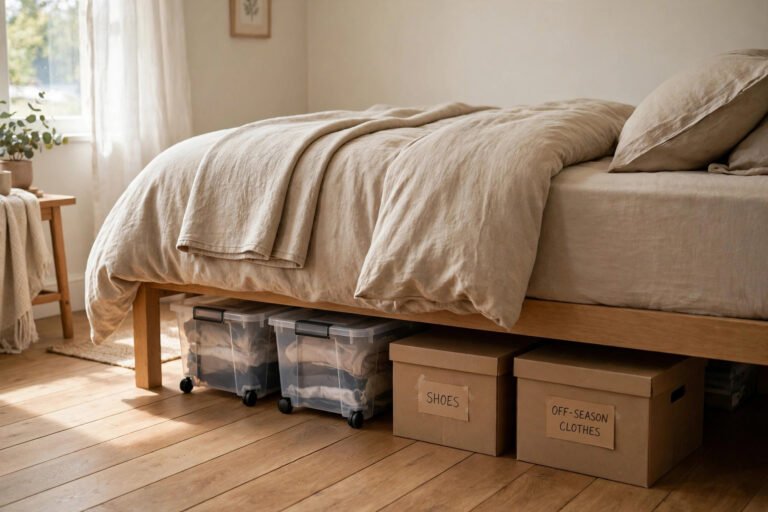
Winter coats, summer sandals and rain boots cannot all live by the door at once. Keep only this season’s gear in the landing zone and rotate the rest to the closet or under-bed storage. Our under-bed storage guide shows where the off-season pile goes, and our small closet organization ideas make room for the coats that do stay.
12. Label the system for everyone who lives there
If you share the apartment, say the system out loud once: shoes on the tray, coats on hooks two and three, keys in the bowl. A system nobody else knows about is a system only you maintain. Write it on a small tag on the basket if you have to — the entryway is the one place where a little labelling is not fussy, it is fair.
The Order to Do It In
Saturday morning: mat, shoe tray, and hook rail — the three things that define the zone. Saturday afternoon: key bowl, mail holder, and the leaving basket. Sunday: mirror, shelf, and the two-minute reset, practised once before the week starts. Total cost, if you thrift the tray and basket: under $40, and every piece moves with you.
A small apartment does not need a foyer to feel finished. It needs one square metre that always works the same way. Build that, and the rest of the apartment stays calmer — our 15 small apartment storage ideas will help you extend the same thinking room by room, and if your living room is the next mess, our small living room makeover guide starts with the same free layout steps.
One Comment