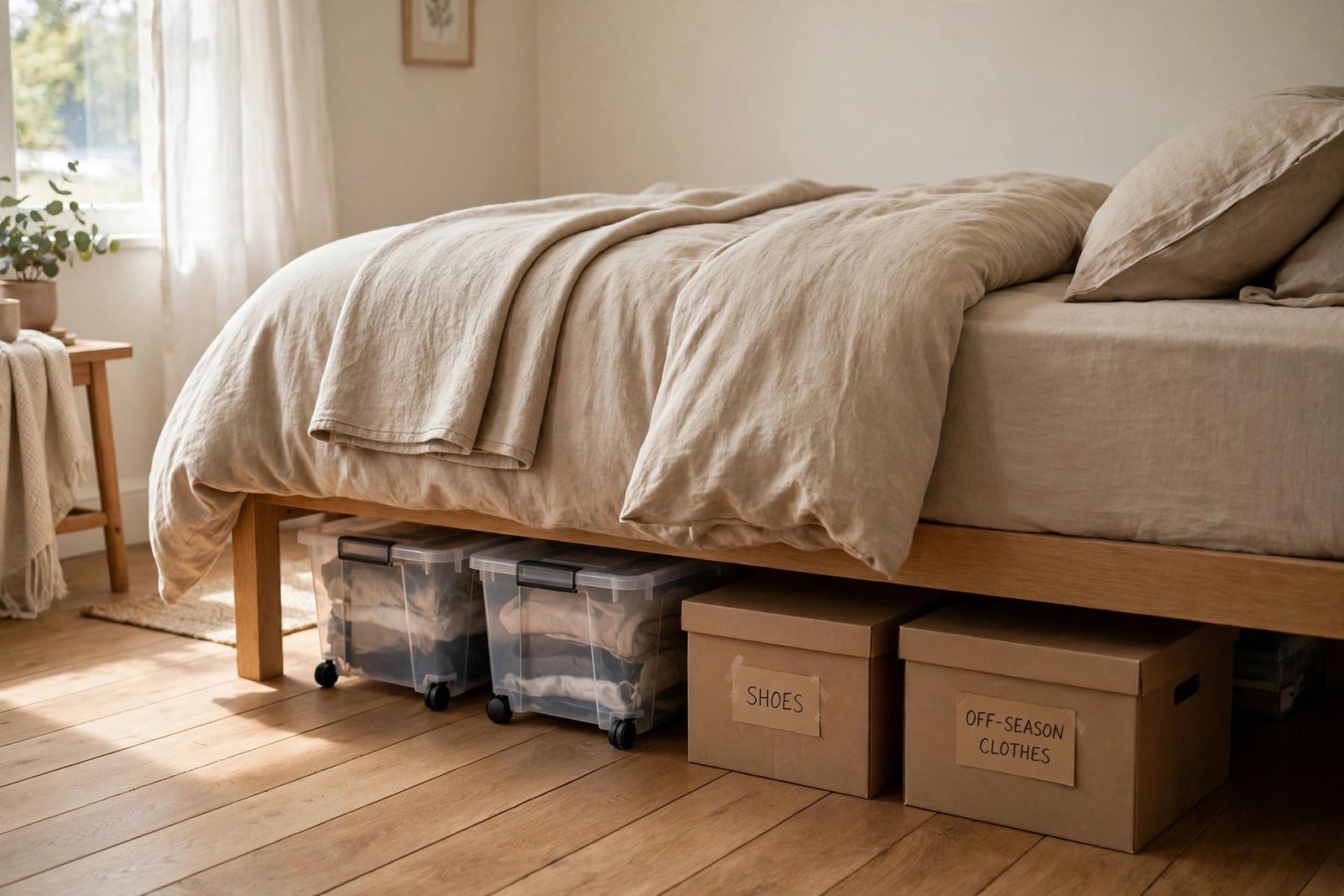
Under-Bed Storage Ideas: 11 Ways to Use the Space You’re Wasting
Look under your bed. In most small apartments, that space is either empty — a whole closet’s worth of storage, wasted — or it is a dusty pile of things you shoved there and forgot. Either way, it is the biggest unused storage area in the bedroom, and it costs nothing to use.
Under-bed storage works when it is contained, labelled, and easy to pull out. Loose piles fail on all three counts. These eleven ideas fix that, starting with measuring, because under-bed storage that does not fit is worse than none at all.
Measure First, Buy Second
1. Measure the clearance — then choose the container
Measure the height from the floor to the underside of the bed frame, and the depth from the side to the middle. Most beds give you 15–25 cm of height. Buy containers at least 3 cm shorter than that clearance, so they slide in and out without catching. If your bed is too low, bed risers — small blocks under each leg — add 10–15 cm of height in five minutes, and they are renter-friendly.
2. Rolling bins beat boxes
A bin with wheels pulls out with one hand; a box without them has to be dragged, which is why it never gets used. Choose low, long bins with lids and wheels, one per category, and label the front edge so you can read it without pulling the bin all the way out. Two bins per side is usually the right number — more than that, and you cannot reach the back one.
What Belongs Under the Bed
3. Off-season clothes, vacuum-packed
Off-season clothes are the perfect under-bed item: you need them twice a year, and they take up a whole closet shelf the rest of the time. Vacuum bags shrink jumpers and coats to a third of their size, and they keep out dust and moths. Label each bag by season and contents, and put the bag inside a rolling bin so it slides out cleanly. Our small closet organization ideas explain which clothes should leave the closet in the first place.
4. Shoes, flat and paired
Shoes stored under the bed stay dust-free and out of the hallway, if they are paired and contained. A flat under-bed shoe organizer with separate compartments keeps pairs together and stops them sliding around. Keep only the shoes you wear this season under the bed; the everyday pair stays by the door, in the entryway zone our entryway organization guide builds.
5. Spare bedding and towels, in one bin
One bin for spare sheets, pillowcases and towels — the bedding you actually use when you change the bed. Fold them flat, stack them by set, and put the set you will use next on top. A lavender sachet in the bin keeps them smelling fresh, and because the bin is labelled, nobody has to dig through three bins to find a fitted sheet.
6. Books, files and keepsakes — in sealed boxes
Books and papers survive under a bed only in sealed, lidded boxes. Open boxes fill with dust, and damp creeps in from the floor. Use one shallow box for the books you are keeping, one for files, and keep anything irreplaceable — photos, documents — in a sealed plastic box, not cardboard. Check the boxes every six months for damp, especially in a ground-floor flat.
What Does NOT Belong Under the Bed
7. Nothing you need weekly
Under-bed storage is for things you need monthly or seasonally, not weekly. If you pull a bin out more than twice a month, that item belongs in the closet or on a shelf instead. Daily clothes, gym kit, and charging cables under the bed are a sign the system is wrong — move them out, and the under-bed space goes back to doing its real job.
8. Nothing loose, nothing food, nothing damp
Loose items slide to the middle and disappear. Food attracts pests. Damp items — wet towels, damp shoes — grow mould under a bed, where nobody sees it until it smells. Everything under the bed goes in a container with a lid, everything is dry when it goes in, and nothing edible ever goes under there.
Keep It Clean and Working
9. Dust it on a schedule, not when you notice it
Under-bed bins collect dust on top and underneath. Vacuum under the bed once a month, when you change the sheets — pull the bins out, vacuum the floor, wipe the bin lids, and put them back. Five minutes, once a month, and the space stays clean instead of becoming the dusty corner you avoid.
10. Label the front, not the top
You cannot read a label on the top of a bin that is under a bed. Label the front edge, in big letters, facing out: “WINTER CLOTHES”, “SHOES”, “SPARE BEDDING”. If you share the bedroom, labels are what stop the other person pulling out three bins to find one thing — and putting them back in the wrong order.
11. The seasonal swap, twice a year
Twice a year — when the weather turns — do the swap: winter clothes out of the closet and under the bed, summer clothes out from under the bed and into the closet, or the other way round. One hour, twice a year, and the closet never has to hold two seasons at once. That swap is the habit that makes the whole small-apartment system work, from the closet to the entryway to the kitchen.
The Order to Do It In
Morning: measure, vacuum under the bed, and decide what goes there — off-season clothes, shoes, spare bedding. Afternoon: buy two or three rolling bins and vacuum bags, pack by category, label the fronts, and slide them in. Evening: put the everyday shoes back by the door and the daily clothes back in the closet, where they belong. Total cost: $25–50, and a whole closet’s worth of space you already owned.
The space under your bed was never wasted space. It was storage you had not organized yet. Use it well, and the rest of the bedroom gets easier too — our $100 bedroom makeover shows how to spend the money you saved on storage, and our 15 small apartment storage ideas extend the same contained, labelled system to every room in the flat.

2 Comments