
Studio Apartment Organization: 12 Zones That Make 400 Sq Ft Feel Huge
A studio apartment has one problem no amount of tidying can fix: one room has to do everything. You sleep, work, eat, dress, relax, and host in the same four walls — so when it feels chaotic, it isn’t because you’re messy. It’s because the room has no assigned jobs. The fix isn’t more storage bins. It’s zones. Divide your 400 square feet into 12 small, clearly purposed areas, give each one only what it needs, and the same room suddenly feels like a small home instead of one big bedroom. Every zone below is renter-friendly and reversible.
How Zoning Works (Read This First)
You don’t need walls — you need edges
A zone is just an area with a visible boundary: a rug, a bookshelf, a curtain, a change of lighting. Your eye reads the boundary, and your brain relaxes.
Give every zone a “closed door”
Each zone needs somewhere for its mess to go — a basket, a drawer, a lidded box. A zone without containment leaks clutter into its neighbours within a week.
Keep walkways sacred
Zones fail when you have to climb over furniture to cross the room. Leave one clear path from door to window, roughly 24–30 inches wide, and arrange zones along it — never across it.
The 12 Zones
Zone 1: The Entry Drop Zone
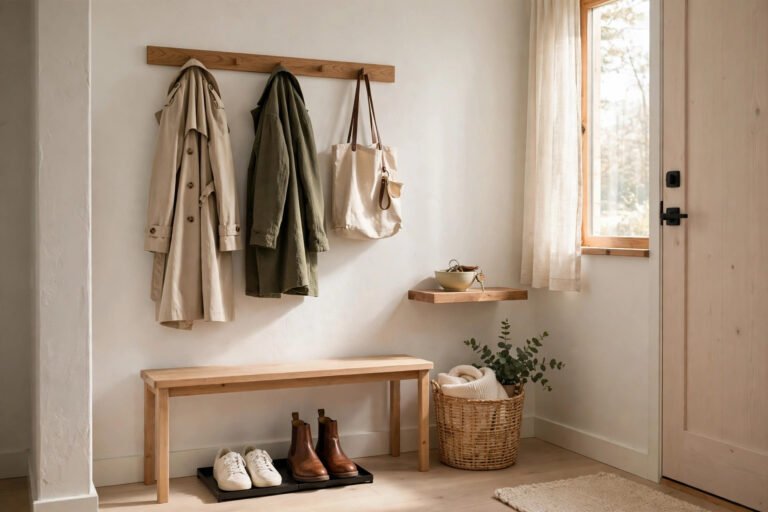
Its job: catch everything that enters. A wall hook row, one small tray or bowl for keys and mail, and a pair-of-shoes limit by the door. In a studio, the entry isn’t a room — it’s a ritual that stops outside chaos at the threshold.
Zone 2: The Sleep Zone
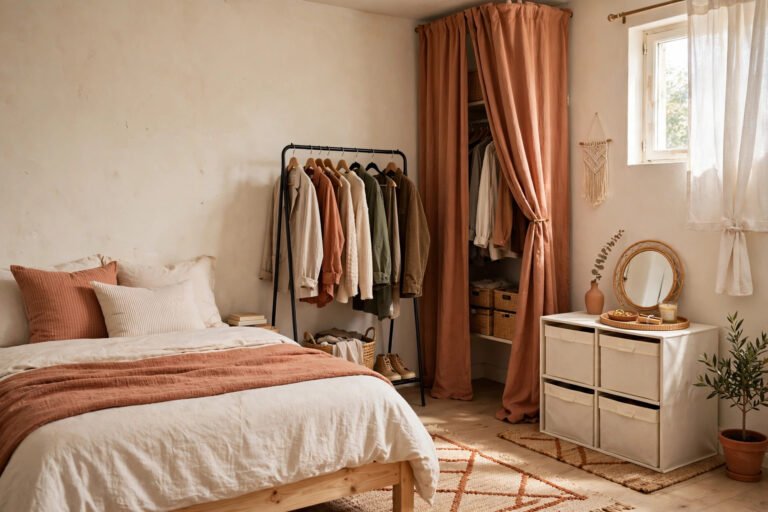
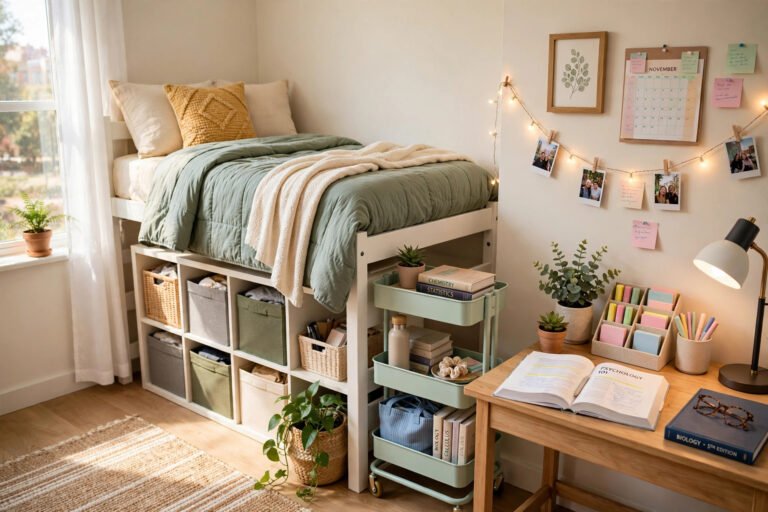
Its job: rest, and only rest. Anchor it with a rug under the bed and keep work items out of sight from the pillow. If you work from home in a studio, this single rule — nothing work-related visible from bed — does more for your sleep than any blackout curtain.
Zone 3: The Dressing Zone
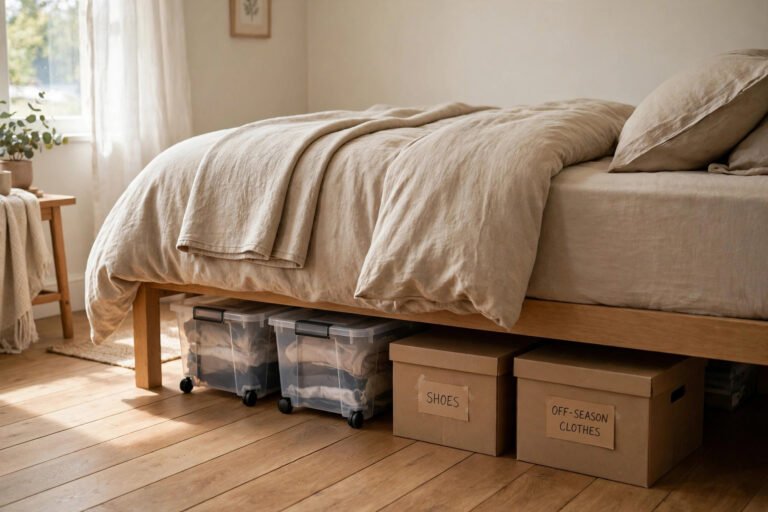
Its job: clothes in, clothes out. Keep your wardrobe, a small laundry basket, and tomorrow’s outfit hook together near the bed, not scattered across it. A slim drawer unit or fabric bins under the bed count as your closet extension.
Zone 4: The Work Zone
Its job: focused work that can end. A small desk (35–47 inches is plenty), a chair that tucks fully under it, and a lidded box or drawer for the laptop and cables at day’s end. When the box closes, the office closes — crucial when your office is six feet from your bed.
Zone 5: The Dining Zone
Its job: eating at a table, not the sofa. A drop-leaf or folding table serves one person daily and four on a Friday. Hang a pendant-style light or place a lamp nearby: a dedicated pool of light makes a two-foot table feel like a dining room.
Zone 6: The Kitchen Zone
Its job: cooking in an arm’s reach. Studios usually come with a fixed kitchenette, so your job is boundaries: a slim rolling cart as a movable island, prep tools only on the counter, everything else vertical — rails, cabinet-door racks, magnetic strips.
Zone 7: The Living Zone
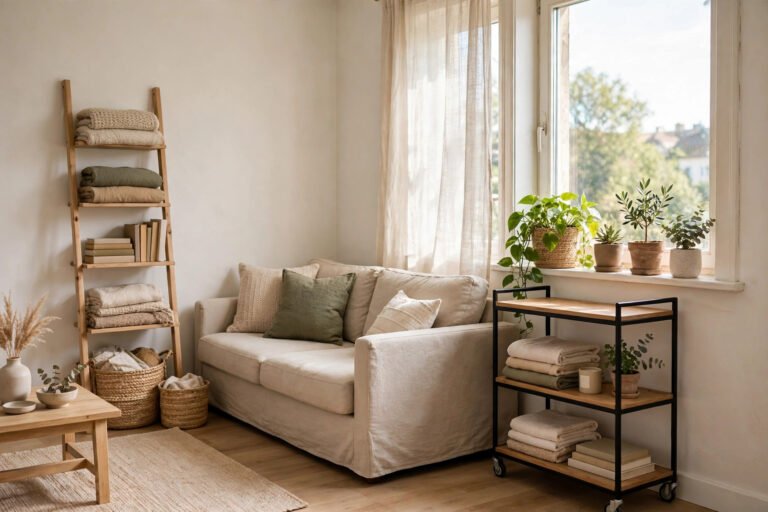
Its job: relaxing and hosting. Define it with the biggest rug your budget allows (it should at least fit the front legs of your seating). One storage ottoman doubles as coffee table, footrest, and the zone’s closed door for remotes, chargers, and blankets.
Zone 8: The Relaxation Corner
Its job: decompression that isn’t a screen. It can be a single armchair, a floor cushion, and a small side table by the window. Studios feel cramped when every seat faces the TV; one corner facing natural light changes the whole emotional temperature of the room.
Zone 9: The Storage Wall
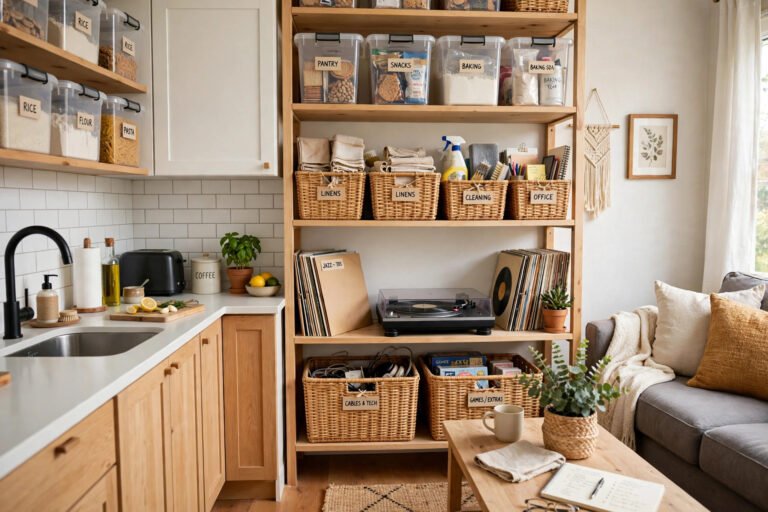
Its job: bulk storage, consolidated. Pick your longest wall and make it the storage wall: tall shelving, baskets, and lidded boxes, all in a similar colour family so it reads as one calm unit. Dispersed storage makes a studio feel like a warehouse; one organised wall makes it feel designed.
Zone 10: The Cleaning Zone
Its job: the reset kit, reachable in seconds. A slim over-door caddy or one cupboard shelf holding a spray, cloths, a hand brush, and bags. Studios get messy at the speed of one person doing everything in one room — a 5-minute reset only happens if the kit is closer than the mess.
Zone 11: The Guest Zone (Yes, Really)
Its job: hosting without a spare room. A folding chair, a spare pillow and blanket in an under-bed bag, and one cleared surface are a guest zone. Knowing you can host stops a studio from feeling like a limitation.
Zone 12: The “Out” Zone
Its job: things leaving. One small basket near the door for donations, returns, recycling, and rubbish-in-waiting. In 400 square feet, what leaves matters as much as what you organise.
Putting It Together: A Sample 400 Sq Ft Layout
Window end: Relaxation Corner + Living Zone (light belongs to waking hours). Middle: Dining Zone on one side, Work Zone on the other, walkway between them. Door end: Entry Drop Zone, “Out” basket beside it, Sleep + Dressing Zones in the quietest corner, Storage Wall along the longest run. Notice the logic: sleep farthest from the door, living nearest the light, work able to close. You can rotate this plan to fit almost any rectangular studio.
The Rule That Keeps It Working
Zones aren’t a one-time project; they’re a weekly 10-minute habit. Pick one zone each week, empty its container, and evict anything that belongs to a different zone. That’s it. Your studio stays a home of twelve small, working rooms — inside one. Start with the zones, then go deeper with our 15 small apartment storage ideas to fill your Storage Wall properly.
Once your zones are set, fill them properly with our 15 small apartment storage ideas.
One Comment