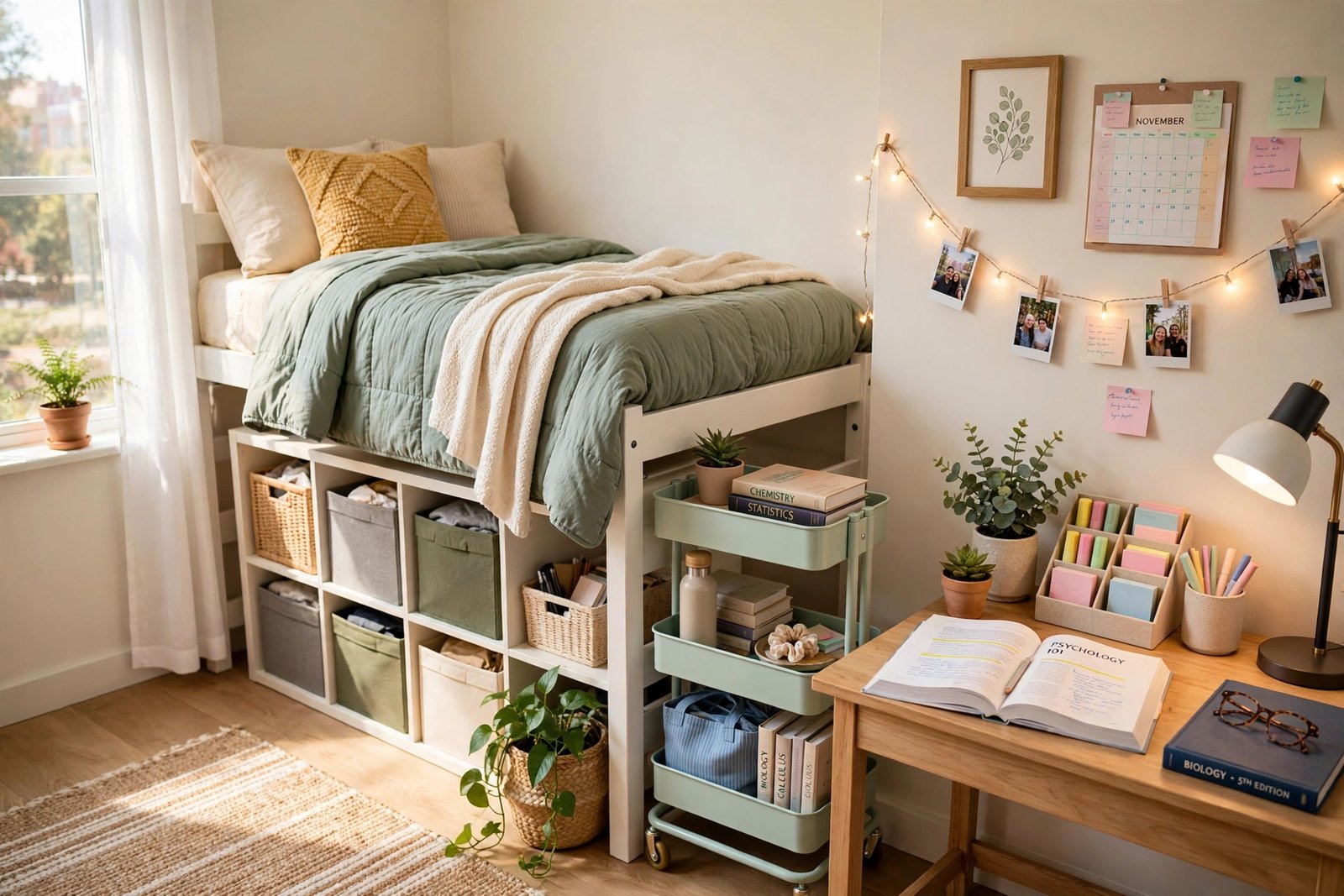
Dorm Room Organization Ideas That Pass Inspection
A dorm room is a small apartment with the difficulty turned up: one room for sleeping, studying, eating and socializing, shared with a roommate, with rules against drilling, nailing, or sticking anything permanent to the walls — and an inspection that can happen with a day’s notice.
Passing inspection is not about cleaning the day before. It is about a room that is easy to keep tidy every day, because everything has a home that fits the rules. These twelve ideas build that room, in the order that matters most.
The Bed: Your Biggest Storage Area
1. Raise the bed and use the space underneath
Most dorm beds can be raised or lofted — check your housing rules first, because some schools allow risers and some allow full lofting. Raised a little, the space underneath holds rolling bins for clothes and shoes, exactly as our under-bed storage guide describes. Lofted fully, it holds a desk or a seating area underneath, and the room effectively doubles. Either way, the bed is storage, not just a bed.
2. A bedside caddy, not a nightstand
There is no room for a nightstand in most dorms. A bedside caddy — a fabric pocket that hangs over the side of the bed frame — holds your phone, charger, glasses, water bottle and book, within arm’s reach, without taking any floor space. It is the dorm version of a nightstand, and it costs less than a pizza.
3. Make the bed every morning — properly
An unmade bed makes a whole dorm look messy, and it is the first thing an inspector sees. A made bed, with the pillows straight and the throw folded, makes the same room look tidy even if the desk is busy. Two minutes, every morning, before you leave for class. It is the single highest-impact habit in this whole list.
The Desk: One Job, One Zone
4. Zone the desk like a studio apartment
Your desk has three jobs: studying, eating, and charging everything you own. Give each job a zone: study on the left with your laptop and books, a small tray on the right for snacks and a mug, and a charging station at the back with a power strip and a cable organizer. When zones mix, the desk becomes a pile — and a pile never passes inspection.
5. Vertical storage above the desk
Desk space is scarce, wall space above the desk is free. A small shelf, a hanging organizer, or a pegboard that leans against the wall — check what your housing allows, because many schools allow leaning and freestanding storage but not wall fixings — holds books, stationery and plants without touching the desk surface. Keep the desk itself to three things: laptop, lamp, and one tray.
6. A cable box and a power strip with a switch
Five chargers, a laptop cable, a lamp cable, and a phone cable turn a desk into a tangle that no inspector likes and no student can clean around. Put the power strip in a small cable box, label each cable with a tag, and use a strip with a switch so everything turns off at night. One box, one switch, no tangle.
Shared Space: Surviving a Roommate
7. Agree the shared zones on day one
A shared dorm fails when nobody agrees what “tidy” means. On day one, agree three things with your roommate: whose side is whose, where shared things live (the mini-fridge, the bin, the cleaning supplies), and what time the room gets a two-minute reset. Write it down. A room with a written agreement passes inspection; a room with an unspoken one argues about it the night before.
8. One laundry basket each, emptied on a schedule
Laundry is the fastest way a dorm fails inspection — clothes on the floor, on the bed, on the chair. One basket each, by your own bed, emptied twice a week on fixed days. If the basket is full, the wash happens that day, not tomorrow. A laundry bag that hangs on the back of the door works if there is no floor space for a basket.
9. The mini-fridge rules
A mini-fridge shared by two people needs rules: one shelf each, nothing without a label and a date, and a weekly clear-out on Sunday night. Anything unlabeled or older than a week goes. An inspector opens the fridge — a clean, labelled fridge is worth more than a tidy desk, because it shows the room is actually lived in properly, not just tidied for the visit.
Inspection-Ready Habits
10. The two-minute reset, every night
Every night before bed: desk cleared to its three things, clothes in the basket or the closet, rubbish in the bin, bed made for the morning. Two minutes. Do it every night, and inspection day is just another day — no panic clean, no hiding things in the wardrobe, no arguing with your roommate at midnight.
11. Keep cleaning supplies in the room
Cleaning supplies stored in another building never get used. Keep a small caddy in the room: a spray, a cloth, a small brush, and bin bags. When the tools are already there, the two-minute wipe actually happens, and the room never gets bad enough to need a big clean before inspection.
12. Store off-season and spare stuff at home, not in the room
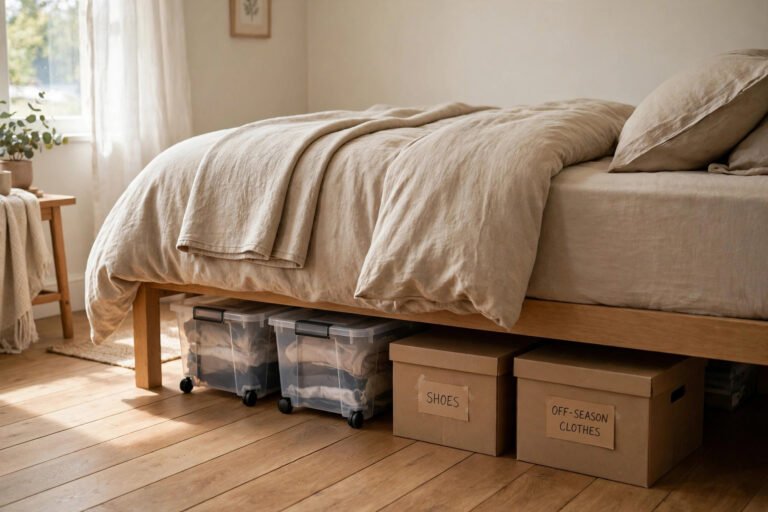
A dorm room cannot hold a whole year of clothes, books and spare bedding. Take only this term’s clothes, and send the rest home — or store it under the bed in one labelled bin, as our under-bed storage guide shows. If it does not fit in your half of the room, it does not live in the room. That rule alone keeps most dorms inspection-ready.
The Order to Do It In
Move-in day: raise or loft the bed, set up the desk zones, and agree the shared rules with your roommate. First week: bedside caddy, cable box, laundry baskets, and the cleaning caddy. After that: the two-minute reset, every night, and the Sunday fridge clear-out. Total cost, if you buy the caddy, the bins and the cable box new: under $50 — and most of it moves with you to your next room.
A dorm room is the hardest small space there is, and it is also the best training for one: if you can keep a shared dorm tidy and inspection-ready, a small apartment afterwards feels easy. The same system scales up — our small closet organization ideas work in a dorm wardrobe, our entryway organization ideas work for the space by the dorm door, and our studio apartment organization guide is the next step when you move into your first flat.



One Comment